
Band Hire : Birmingham and the midlands, Band Hire : Bristol and the south west, Band Hire : London and the south east, Band Hire : Manchester and the north, Band Hire : Scotland, Swing & Trad Jazz
The Iconic Sound Of New Orleans Trad Jazz : Dixieland Trad Jazz – The Signature Sound Of New Orleans
Marching bands of musicians were commonly employed to accompany wedding and funeral processions in the culture of the French-influenced enclave of Louisiana and the city of New Orleans. By the turn of the 20th century, these strolling players had become something of an institution, and their particular choice of instrumentation and distinctive style of music began to develop a character all of its own.
Processional music has always played an important role in many cultures, be it for religious, military or other social functions. Very often, the same musicians who played for religious gatherings would also perform for more festive secular occasions. The 19th-century novelist Thomas Hardy inherited from his father (a church musician) a compendium of hymns, psalms and anthems for Sunday use, at the back of which was written a comprehensive assortment of folksongs and tunes from his native Dorset, no doubt performed the previous evening in more relaxed and raucous surroundings!
The origins of the music can be found in hymns, spirituals, gospel, ragtime, blues and brass band styles popular at the turn of the century, and the resulting amalgam represents an early fusion of inherited European melodic and harmonic influences with their African/American negro counterparts.
There is an obvious parallel to be drawn between this pragmatic turn-of-the-century intermingling of the sacred and the secular and the style of music played 4000-odd miles to the southwest by traditional marching bands in New Orleans. Although the European influence is predominantly French rather than British, the style of music (and its repertoire) reflects immediate origins in gospel hymns and spirituals as much as from locally-inspired popular ragtime and blues.
Improvised melodic counterpoint over a firmly-established marching bass
Gospel-inspired improvisation overlaid on a strongly-maintained theme

Find out more about booking trad jazz bands for weddings or parties.
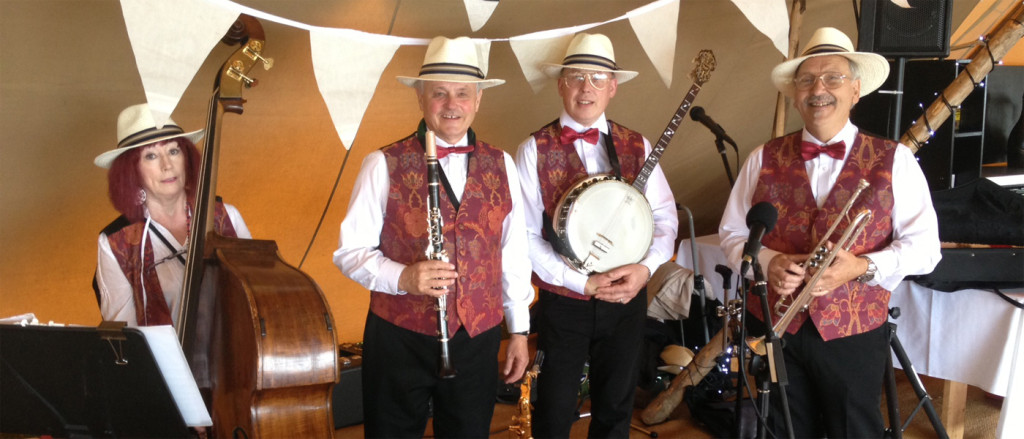
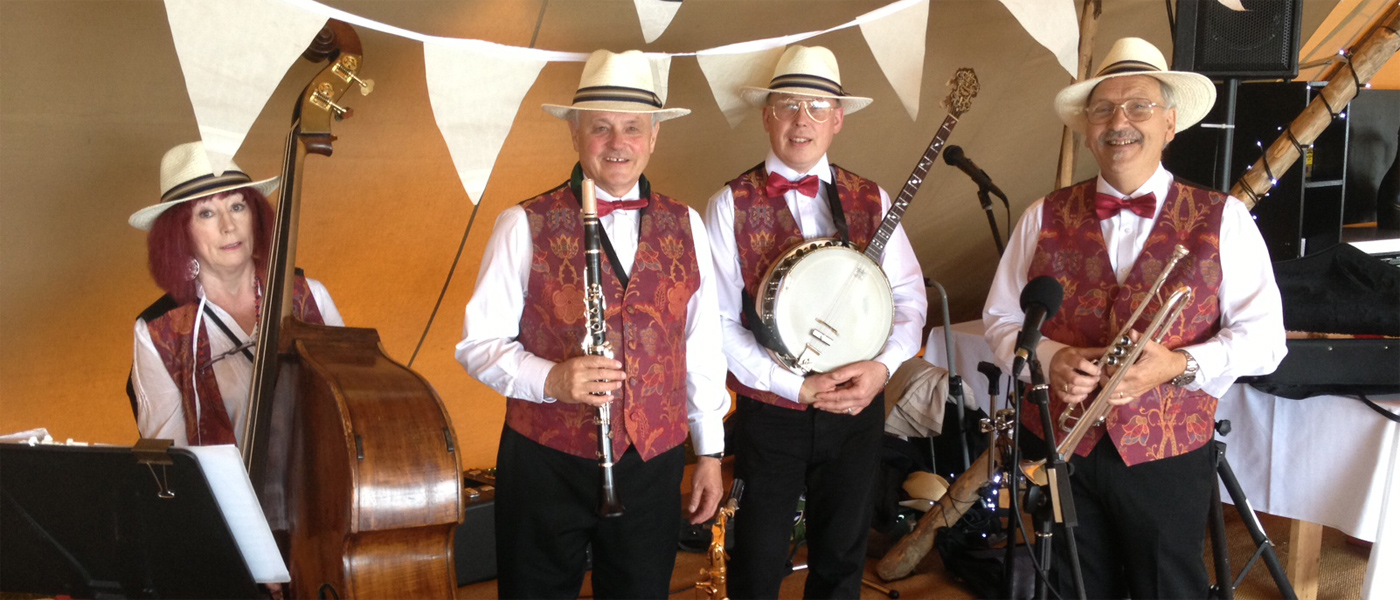
Typical instrumentation of a Dixieland or New Orleans marching band would be a permutation of sousaphone, euphonium or double-bass, then banjo for rhythm and harmony, topped off with trombone, trumpet and clarinet interweaving a conversation of melodic ideas. Sometimes guitar might be added to support or replace the banjo, and saxophone makes an occasional topline appearance. Solid rhythm could be provided by a portable bass drum, or if the band were performing statically, drumkit became a possibility.
The archetypal New Orleans marching band of c.1900 is loosely modelled on a military-style brass band of the period, with somewhat changed instrumentation. Banjo or guitar would provide the rhythmic and harmonic framework, underpinned by a steady bassline from either double-bass, sousaphone or euphonium. Topline instruments might include clarinet, trombone and trumpet, each playing improvised variations of the melody, often simultaneously and interactively, as if in animated dialogue.
The signature characteristic of the New Orleans or Dixieland sound is this interweaving dialogue between the topline musicians, forming a complex latticework of melodic invention over, under and around the main theme, securely underpinned by the accompanying instruments. This simultaneous conversation, potentially verging on the cacophonous, is the springboard medium for the evolving musical style that became known as jazz (a negro word with diverse and obscure connotations).
This interweaving sustained conversation between the melody instruments is the defining characteristic of the music that came to be known as Jazz, and was later distinguished from further developments within the emerging genre by the term ‘New Orleans’, ‘Dixieland’ or ‘Trad’ Jazz. The syncopating cross-rhythms of ragtime endowed the music with an urgent, eminently danceable feel, and like the folk music of certain other cultures, could transform an elegaic lament at one moment to a mood of joyous celebration at the next, in the blink of an eye.
In the intervening century which saw the dawning of the recording and cinematic age, jazz as a musical genre in its own right has inexorably burgeoned into a global phenomenon, taking on influences from further afield and in turn influencing the development of both art and popular musical culture. For many people, however, the term will forever be associated with the joyous, celebratory, carnival spirit immediately conjured up by Dixieland or Traditional Jazz.
The 20th century saw the inexorable and extremely rapid development of the telecommunications age we nowadays take for granted. Those 4000 miles of ocean, hitherto such a barrier, gradually became irrelevant, as more and more disparate types of music were recorded, broadcast and shipped around the world. This not only attracted a pan-American and European audience for the fledgling musical genre, but stimulated a reciprocal transfer and exchange of ideas, forms and styles. Over the years, jazz and other popular folk music has developed and morphed almost beyond recognition, but for many of its countless aficionados worldwide, the term jazz will be forever associated with the original style of music that emerged in Louisiana – Dixieland.
The continuing popularity of Dixieland and Traditional Jazz
The enduring popular attraction of Traditional New Orleans Jazz
One of the major advantages of Trad Jazz is that its performance, being completely acoustic, is eminently portable, and equally effective outdoors or indoors. The light-hearted, joyful , toe-tapping sound combined with the straw-boatered, striped blazered image favoured by many such bands effortlessly presents the perfect backdrop for weddings, birthday parties and other celebrations.
As with all fashion, popular music crazes and fads come and go in regular cycles, soon to be replaced by the latest cunningly-packaged phenomenon. Howevever, Dixieland and Trad Jazz has managed to buck the trend, retaining the iconic aura of a survivor from a bygone age, most likely because it presents an instantly recognisable sound that generally invokes a spring in the step and puts a smile on the face. Owing to its enduring popularity, there are quite a number of specialist bands devoted to the genre all around the UK, in turn helping to sustain its cultural status.
Trad Jazz is an instantly recognisable form of music which usually brings a smile to everyone’s face. Unsurprisingly for such a popular form of musical entertainment, there are a considerable number of Trad Jazz Bands operating all across the UK, so it shouldn’t be too difficult to track one down.
Traditional New Orleans Jazz is essentially entertainment music. It is usually played acoustically, and doesn’t require amplification, so can readily be performed in an outdoor setting, the smartly-attired musicians often strolling amongst their audience as they play. This makes it an ideal choice of musical entertainment for garden parties, summer fetes and other such events.
Dixieland and New Orleans Trad Jazz is wonderful, colourful, carnival stuff, and makes for a great festive party atmosphere at all types of celebration. Strike up the band!
The iconic sound and visual impact of a Dixieland or New Orleans Trad Jazz Band is guaranteed to generate an atmosphere of light-hearted celebration at almost any social gathering, be it a birthday party, a wedding or any other similar occasion. A carefree carnival spirit is immediately conveyed through the irresistible toe-tapping rhythms and jostling melodic patterns which are the signature features of this infectiously joyful music.
Leave a reply